
Running a Sex Offender Check in Highlands County
The Florida Sexual Offender and Predator Registry is the controlling public source. FDLE receives registration information from local law enforcement, the Florida Department of Corrections, driver licensing authorities, courts, and registrants. HCSO handles local registration and compliance contacts, but the statewide portal is the main public search.
Choose the route by purpose. A person search works when a name or partial spelling is known. A county filter can return Highlands County results without a name. Neighborhood Search centers a map or list on an address. The alert service is better for ongoing awareness because it can track activity near a location or changes tied to a specific registrant.
Filter the Highlands Offender Registry
A countywide review does not require a person's name. Leave the name fields blank, select Highlands in the County menu, and keep “Both” as the offender type unless a narrower designation is needed. Status filters can further separate released people, absconded records, confinement, supervision, and other legal states.
The image comes from the official FDLE person-search form.
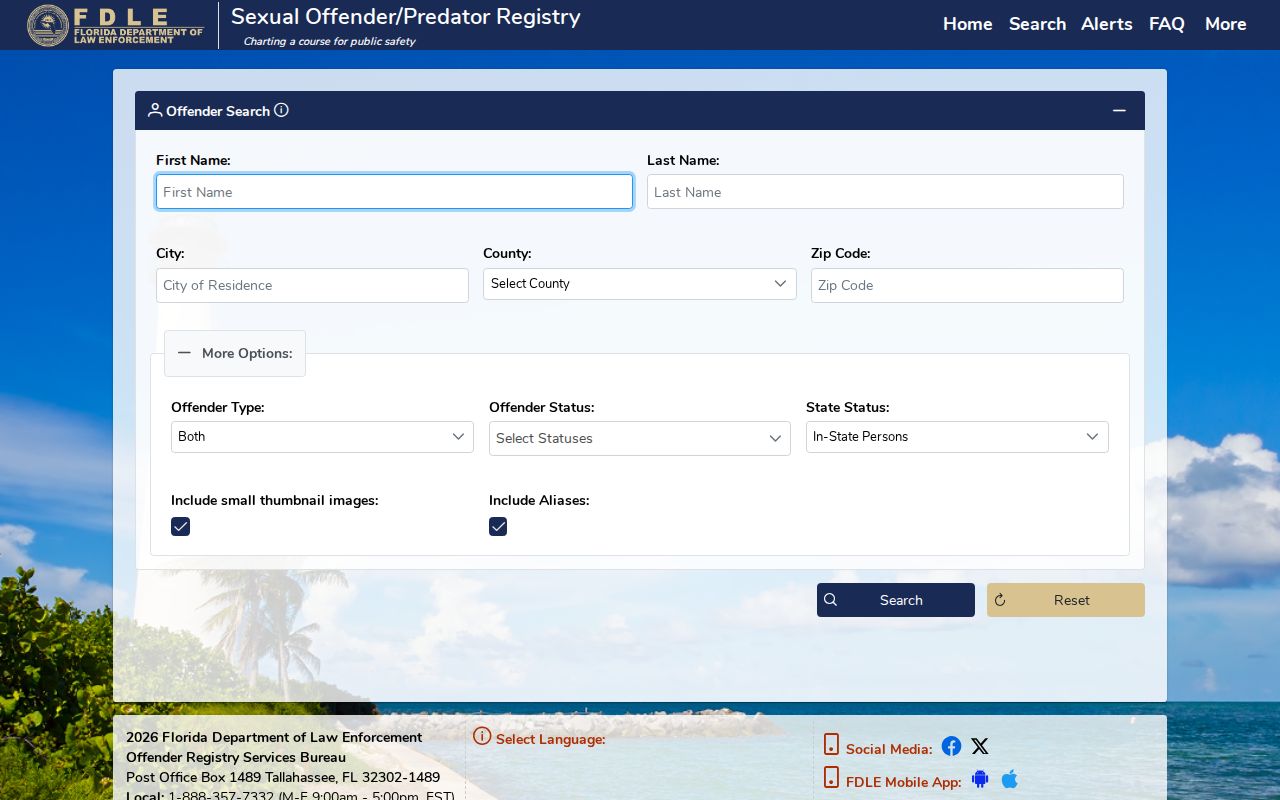
The controls for thumbnails and aliases affect how results appear. They do not expand or narrow which legal registration offenses are included.
Searching the Florida Sexual Offender and Predator Registry
FDLE offers partial-name support and several location and status filters. More filters can reduce false matches, but a broad first search is useful when spelling or present location is uncertain.
- Open the official FDLE registry and review its search conditions and warning.
- Enter a name, city, ZIP code, or select Highlands County. Add offender type or status only when helpful.
- Compare results by identity, designation, status, and address rather than relying on name alone.
- Open the full profile, read the qualifying offense and reported-address details, and verify time-sensitive information.
| Field Label | Type | Required | Notes |
|---|---|---|---|
| First or Last Name | Text | Conditional | Partial names are supported |
| City or ZIP Code | Text | Conditional | Searches reported residence data |
| County | Dropdown | Conditional | Select Highlands for countywide results |
| Offender Type | Dropdown | No | Offender, predator, or both |
| Offender Status | Multiselect | No | Includes absconded, confinement, released, supervision, and other states |
| State Status | Dropdown | No | In-state, out-of-state, or both |
Note: A registry listing covers qualifying registration history, not every arrest, charge, or conviction in a person's Florida record.
Map Highlands Registry Addresses
The FDLE Neighborhood Search accepts an address, city, ZIP code, and state. Results can appear as a map or list. The radius menu ranges from one-quarter mile through five miles, allowing a focused check around a home, school route, park, or other place important to a family.
The official address-radius interface is shown below.
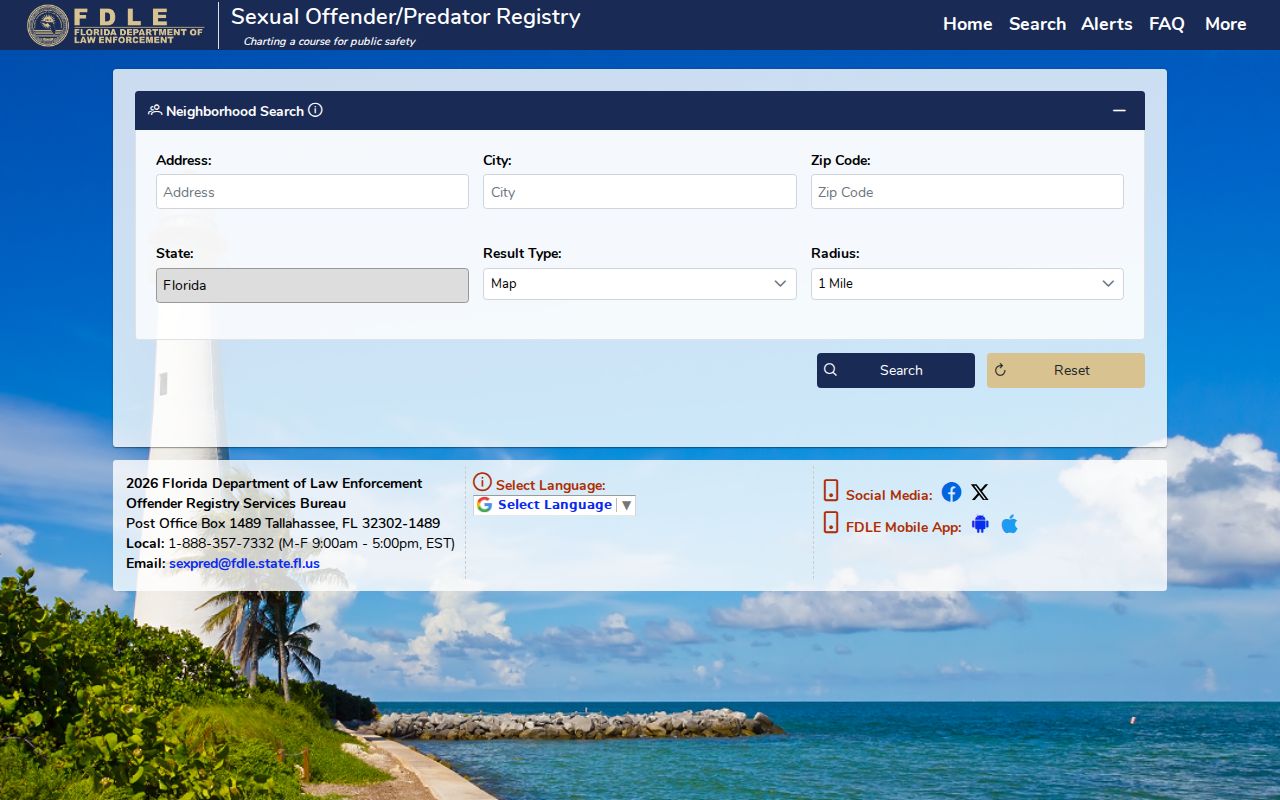
Begin with the smallest useful radius. A broad circle can create a long result list and make it harder to tell which map marker relates to the location. The legend distinguishes offenders, predators, and transient markers.
Map meaning: A marker reflects reported registry data. It does not predict future conduct and should be checked against the full profile.
What a Registry Profile Shows
An FDLE flyer or profile combines identifying information with designation, legal status, reported addresses, and qualifying offense details. Some data collected during registration is sensitive and is not necessarily displayed to the public.
| Name & Aliases | Primary name and reported aliases used to compare possible matches. |
|---|---|
| Photo & Description | Photograph, DOB, race, sex, height, weight, hair, eyes, scars, marks, and tattoos when published. |
| Reported Address | Permanent, temporary, or transient location information and related status. |
| Offense Details | Qualifying offense, conviction place and date, and adult or minor victim indicator where displayed. |
| Designation | Florida Sexual Offender or court-designated Sexual Predator, not a generic numbered risk tier. |
| Registration Status | Release, confinement, supervision, absconded, or another current legal-status category. |
| Other Reported Data | Vehicles or higher-education information when applicable and public. |
FDLE warns that information can change quickly and comes from several reporting sources. Compare a profile's current labels and dates, and contact the proper office when an address appears wrong.
Read Highlands Offender Flyers Carefully
The registry's designation is not a score. Florida does not publish the familiar Level 1, Level 2, and Level 3 system as its main public classification. “Sexual offender” and “sexual predator” are legal categories, while status describes matters such as release, confinement, supervision, or absconding.
FDLE's official profile and scope explanations provide the neutral reference shown here.
The flyer identifies a reported record. It does not prove where a person is at a particular moment, establish a new offense, or replace a complete FDLE criminal-history review.
Registration Requirements and Levels in Florida
Florida's rules turn on statutory category and court designation rather than three public risk tiers. Registration is generally long-term, and reporting frequency differs. Individual obligations can depend on the conviction, court order, release status, and other statutory facts.
| Florida Category | Duration | Re-registration |
|---|---|---|
| Qualifying Sexual Offender | Generally lifetime, subject to narrow statutory relief | Generally twice yearly |
| Sexual Predator | Generally lifetime | Quarterly |
| Specified or Juvenile Category | Depends on statute or court order | Quarterly where the governing law requires |
HCSO is the local registration office. Registrants must report initial residence or release and specified changes within the applicable time, often 48 hours. Members of the public should call HCSO for current registration-office directions and hours rather than arriving at jail intake.
HCSO Feeds the Highlands Registry
Local registration and statewide publication are connected but distinct. HCSO receives required Highlands County registrations and changes. FDLE operates the public database. Other agencies, including FDC and driver licensing authorities, also report information used in registry records.
If an address or compliance fact appears wrong, report it to HCSO or contact FDLE Offender Registry Services at 1-888-357-7332, Monday through Friday from 9 a.m. to 5 p.m. Eastern, or sexpred@fdle.state.fl.us. Give the profile or identifying details and explain the apparent problem. Do not confront the listed person or household.
Note: For an immediate threat, call 911; the registry correction channels are for data and compliance concerns, not emergency response.
Set a Highlands Offender Alert
The Florida Offender Alert System can follow changes near a chosen location or tied to a particular registrant. That makes it more practical for ongoing community awareness than repeating the same manual search. Enrollment is free through the official FDLE service.
Alerts still depend on reported registry data. They should support ordinary safety planning, such as reviewing family routes and keeping contact information current. They do not guarantee real-time notice of every movement and do not replace police or emergency services.
Choose the location option when awareness around a fixed Highlands County address matters most. Choose the specific-person option when an already identified profile is the focus. Keep the enrollment email current and open each notice through the official FDLE channel. If a notice conflicts with the live profile, treat the profile as time-sensitive and ask FDLE or HCSO to confirm the reported information.
Add NSOPW to Highlands Checks
A Florida-only search can miss a relevant record maintained by another jurisdiction. The U.S. Department of Justice's National Sex Offender Public Website, or NSOPW, joins participating state, territorial, and tribal public registries for a broader official search.
The official NSOPW search interface is pictured below.
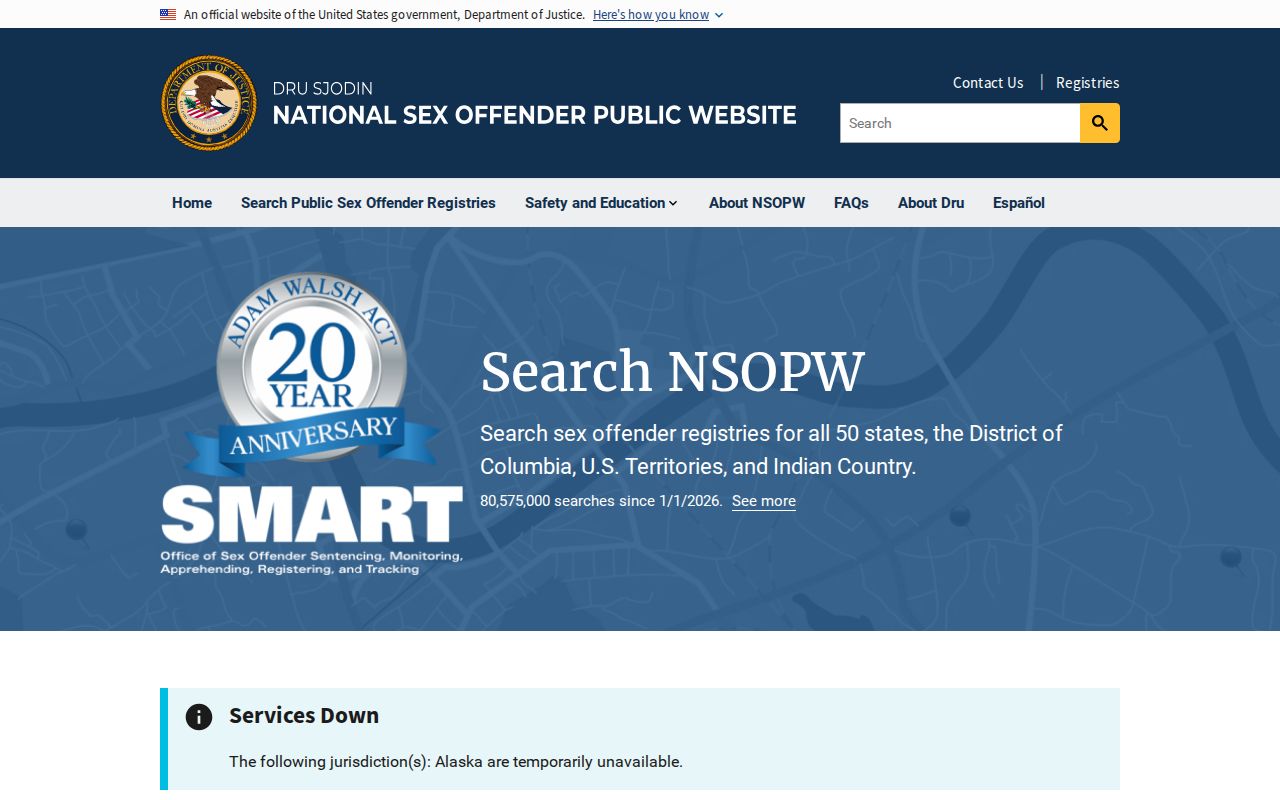
Use NSOPW when a name, address history, or family safety question crosses state lines. Return to the source jurisdiction's profile for its legal terms and latest details.
Search coverage can differ because each participating jurisdiction supplies its own public data under its own law. A national no-result therefore should not be treated as a certificate that no registration record exists. Check likely states directly when the location history is known, and compare identifiers before concluding that two similar names refer to the same person.
Lawful Use and Community Notification
Registry information exists for public awareness and safety planning. Florida Statutes section 775.21 also requires community notification for sexual predators in specified circumstances, including notice to licensed child-care facilities and K-12 schools within one mile. That public function does not authorize threats, intimidation, harassment, or vigilante action.
Use registry information lawfully: FDLE states that registry data must never be used to threaten, intimidate, or harass a registrant or household. Misuse can be a crime.
Verify material facts before acting on them. Report an apparent violation to HCSO or FDLE, and use emergency services for an immediate danger. A map point or profile supports informed caution. It is not a license to punish, exclude, or confront someone.