
How to Check Criminal History in Lake Placid
Start with Lake Placid Police when the incident began inside town jurisdiction and its officers handled the call. Shift to HCSO for county custody, then to the Clerk for what prosecutors filed and how the court resolved each count. A Florida repository result adds statewide reach, but it does not replace those local source documents.
- Confirm that Lake Placid Police, rather than HCSO or another agency, handled the event.
- Request the town report with the date, time, location, involved party, report number if known, and exact media sought.
- Use HCSO Inmate Search for present county custody after a town arrest and jail transfer.
- Search the Highlands Clerk's Circuit or County Court channels for filed charges, hearings, orders, and disposition.
- Use FDLE Instant Search or the free fingerprint Personal Review of your own Florida history when local files do not answer the statewide question.
Keep every identifier received. The town report number, HCSO booking number, Clerk case number, and FDLE transaction identifier can all refer to the same event without being interchangeable.
The Lake Placid Police Records Route
Lake Placid maintains a town Police Department, making it the first public-record custodian for reports its officers create. The official town police page is the place to confirm the current street address, telephone, email, hours, form, fees, and delivery choices. The research does not support assuming that Lake Placid uses the same form fields or prices as Sebring.
The official Lake Placid town homepage is the stable municipal entry point when a deep police link changes.
The town source helps locate the current public-record contact, while HCSO and the Clerk remain separate county custodians for booking and prosecution.
The Lake Placid Police Department
Ask Lake Placid Police for the incident or offense narrative, town arrest paperwork, photographs, CAD or dispatch material, and video created or kept by the department. A focused request should identify requester contact, report type, event date and time, location, involved party, report number, desired media or certification, and preferred delivery.
Required fields depend on the live town form. If a dedicated online case search is unavailable, that is not an end point. Submit a police record request, check HCSO for current custody, and use the Clerk for a filed court case. The department cannot provide a court disposition merely because its report started the matter.
Active investigation material, juvenile information, protected victims, confidential sources, account data, and other exempt content may be withheld or redacted. Asking for a precise video time segment can reduce review work and make the request easier to process.
Three Lake Placid Criminal Records From One Event
A town incident can yield three core records. Lake Placid Police describes what officers reported and the probable-cause basis for an arrest. HCSO intake documents the booking and custody. The Highlands Clerk records the charging decision, hearings, orders, and outcome. The files complement one another but do not prove the same facts.
| Source | Record focus | Best question |
|---|---|---|
| Lake Placid Police | Incident, investigation, arrest narrative, town media | What did town officers document? |
| HCSO jail | Booking, received charges, bond, present custody | Was the person booked or currently held? |
| Highlands Clerk | Filed counts, docket events, orders, disposition | What became a case and how did it end? |
A charge on the booking record can change before filing. Read the court outcome count by count and do not treat a bond amount as a fine or finding of guilt.
Arrests and Bookings in Lake Placid
After a Lake Placid arrest transfers to the Highlands County jail, HCSO creates a separate intake record. The public roster's “Type to Search” box filters current listings. It is useful for a recent booking or present custody, but it is not a complete archive of all Lake Placid arrests.
A released person may be absent even though the town police report and court case remain. If the roster does not answer the question, request the town report and search the Clerk. If HCSO itself handled the original event, use HCSO Public Records rather than Lake Placid Police. The responsible agency is determined by who created the record, not merely by the town named in the location.
Note: Current custody is a changing status, while guilt or dismissal must be read from the court's final disposition.
Mural District Incidents and Lake Placid Jurisdiction
Lake Placid's more than 40 public murals, caladium identity, and southern-lake setting make location descriptions especially useful in a records request. A mural name, nearby street, business, date, and tight time range can help identify the event when the report number is unknown. Local color is useful only when it improves record matching.
Jurisdiction still needs confirmation. A location associated with Lake Placid may be inside town limits or in a nearby area served by HCSO. Check the agency on any citation or paperwork. When no document is available, give each likely custodian the exact location and ask whether it holds a responsive report rather than sending an overly broad countywide request.
Lake Placid Municipal Court Records
Lake Placid does not operate a separate municipal criminal court or town criminal-case portal. Applicable local ordinance matters, misdemeanors, and criminal traffic proceed in Highlands County Court, while felonies belong in Circuit Court. The Highlands Clerk maintains both in the Tenth Judicial Circuit courthouse system.
| Court Name | Highlands County Court and Highlands Circuit Court |
|---|---|
| Case Types Heard | County misdemeanor, ordinance, and criminal traffic; Circuit felony |
| Case Lookup Channel | Clerk court services, public Circuit and County calendar lists, or Clerk counter |
| What the Docket Shows | Case number, charge, judge, event, attorney, custody or bond notation, and reported outcome |
| Copies & Fees | Confirm the current copy, certification, account, counter, and delivery requirements with the Clerk |
The calendar lists scheduled court events and can change. Obtain the register of actions and signed order or judgment when a complete or definitive record is needed.
When a Lake Placid Report Has No Court Case
A police report does not guarantee that prosecutors filed a charge. Lake Placid Police may document a call, investigation, or arrest that never becomes a Highlands case. The State Attorney reviews the matter and decides whether and what to file, so an empty court search cannot be used to claim that the town report never existed.
First confirm the event with the town Police Department. If an arrest and county intake occurred, preserve the HCSO booking details. Then ask the Clerk by name, approximate year, and case type. If no prosecution exists, the police report may be the only responsive local record, subject to public-record exemptions.
Likewise, HCSO news is selective public-safety communication rather than a complete arrest log. An event missing from news should be pursued through the actual town, jail, and court custodians.
Where Lake Placid Records End Up
Town police records move outward only when later stages occur. A jail transfer creates HCSO booking data. A charging decision creates a Highlands court file. Qualifying arrest fingerprints and reported dispositions reach the Florida Department of Law Enforcement repository under state reporting statutes.
Record flow: Lake Placid Police Department › Highlands County Courts › Florida Department of Law Enforcement
The flow is not perfectly synchronized. A recent town report or booking can appear before the court file opens, and an FDLE cycle can lack a disposition if reporting is delayed or unmatched. Use the town for narrative detail, HCSO for present county custody, the Clerk for the case history, and FDLE for statewide Florida history.
Older Lake Placid Criminal Cases at the Clerk
The public Circuit and County Court calendar lists are useful for scheduled events, not a comprehensive old-case archive. If an older Lake Placid matter is missing, contact the Clerk with the full name, approximate year, case type, and any known case number. Ask for a register of actions, charging document, disposition, sentence, or certified copy by name.
Do not confuse Acclaim Official Records with the criminal docket. Acclaim searches recorded instruments using name, dates, book type, instrument type, book and page, legal description, and other fields. Those tools are useful for official recorded instruments, but a criminal prosecution remains in the Clerk's court-record system.
The Highlands criminal court case page explains the CF, MM, and TT file labels and the difference between a calendar snapshot and a final docket.
Lake Placid Record Errors and Fingerprint Review
A demographic FDLE result can confuse people with similar names. When reviewing your own Florida criminal history or challenging an error, FDLE Personal Review offers the stronger fingerprint-linked route and does not charge a fee. Fingerprints must be taken by a criminal-justice or law-enforcement agency, then mailed with the application to FDLE.
The FDLE Personal Review application is the official self-review form.
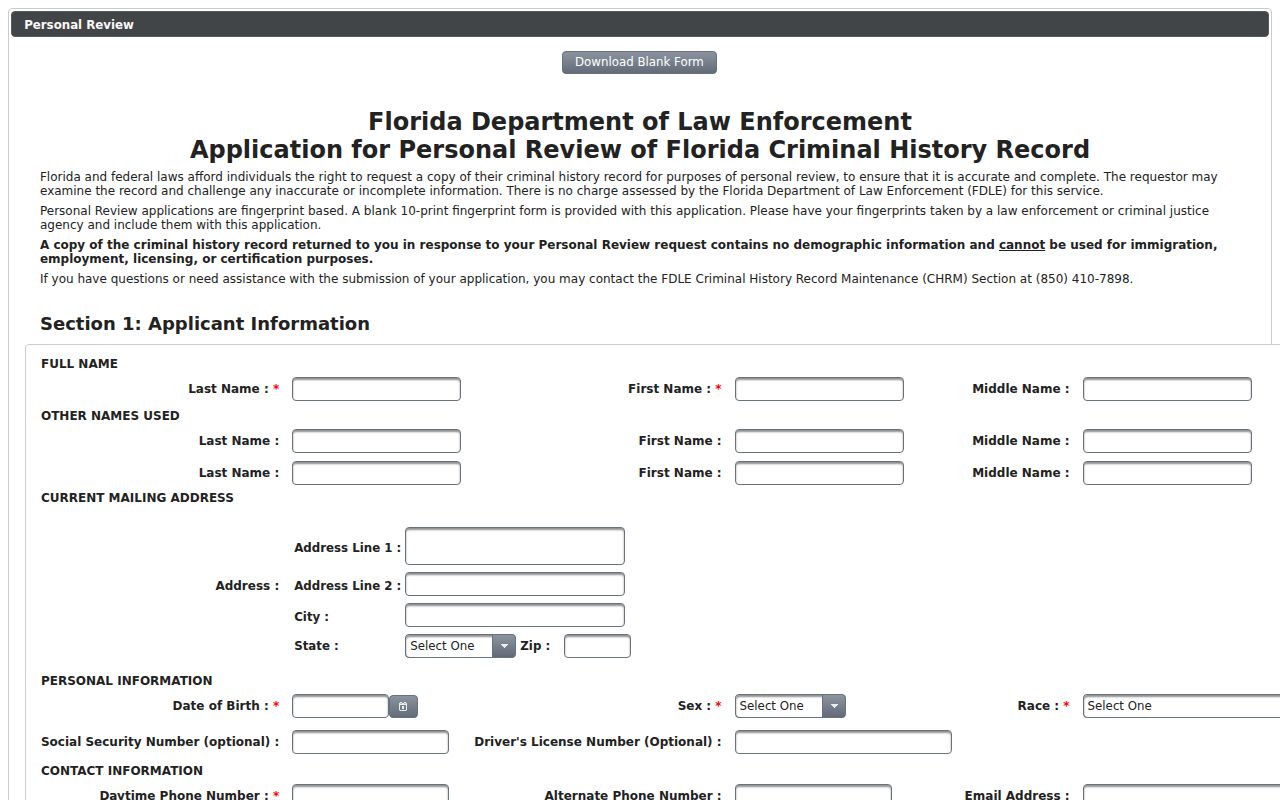
If the FDLE history lacks or misstates a Lake Placid case outcome, obtain a certified Highlands Clerk disposition. Document the agency, URL, date, identifier, and field in conflict before using the section 943.056 challenge channel.
Requesting Lake Placid Police Video Precisely
Video, CAD, dispatch, and 911 material can require more review than a short written report. Give the town the precise date, location, event time window, officer or unit if known, report number, and the segment sought. A request for all video across a broad period can trigger more retrieval, review, redaction, and possible special-service cost.
Florida law allows inspection and copying of nonexempt records under reasonable conditions. It also protects active investigative details, listed victim information, juvenile material, undercover or informant information, and sensitive personal data. Redaction does not necessarily mean the whole Lake Placid record is closed.
Ask the town to identify the legal basis for any denial. If the record was actually created by HCSO, redirect the same precise description to the sheriff's public-record channel.
Public Access Rules for Lake Placid Records
Florida Constitution article I, section 24 and chapter 119 establish broad access subject to constitutional and statutory exemptions. A requester generally does not need to state a purpose or use a special form, though written scope makes a Lake Placid request easier to track. Ordinary duplication cost and a reasonable extensive-use service charge may apply.
Sealed, expunged, juvenile, active investigative, and protected-identity material follow separate restrictions. The town police report, sheriff booking file, court case, and FDLE history must each be requested from the custodian that maintains it.
Key Statutes:
Florida Statutes §119.07 governs inspection, copies, ordinary charges, and extensive-use service charges.
Florida Statutes §119.071 lists active-investigation and protected-information exemptions.
Florida Statutes §943.056 gives a subject the right to review and challenge Florida criminal-history information.