
How to Check Criminal History in Sebring
Begin with the office closest to the event. A Sebring Police Department report can document a call or investigation even if no arrest followed. If an arrest led to county intake, the current HCSO roster answers the custody question. The Clerk then becomes the source for charges the State Attorney actually filed and for the final result.
- Ask Sebring Police for the incident, offense, arrest, video, or other city-created record.
- Identify the event with a date, location, involved party, report number if known, and the exact media sought.
- Check the HCSO current inmate roster when the question concerns a recent booking or present custody.
- Use the Highlands Clerk and Tenth Judicial Circuit channels for a Circuit felony or County Court misdemeanor file.
- Use an FDLE statewide name search, or fingerprint Personal Review for your own Florida record, when city and county files are too narrow.
The city, jail, court, and FDLE records can carry different numbers and update on different schedules. Preserve the police report number, booking number, and court case number rather than expecting one identifier to work at every counter.
Sebring Criminal Records on the Downtown Campus
Sebring is both a city and the Highlands County seat, which puts several record keepers within a compact downtown cluster. The Highlands County Courthouse is at 430 South Commerce Avenue. HCSO headquarters is at 400 South Eucalyptus Street, the State Attorney building is listed at 411 South Eucalyptus Street, and jail intake uses 338 South Orange Street.
The short distance between these offices does not merge their files. A person seeking a signed judgment should use the Clerk, while someone seeking a city police narrative should not assume the courthouse has it. City Hall provides useful orientation to the local government side of that split.
The official Sebring homepage shows the city's government entry point.
That city source is the right starting place for current municipal contact details, while county justice records remain with their named county custodians.
The Sebring Police Department
The Sebring Police Department creates the first official record for an incident investigated within city jurisdiction. That may include an offense report, arrest paperwork, photographs, dispatch material, or video. The department's official police page is the source to confirm the live records address, telephone, email, hours, submission method, and any current fee before making a request.
A precise request should name the report type, approximate date and time, location, involved party, report number if known, desired media, certification need, and delivery preference. Whether a field is mandatory depends on the current city form. Narrow detail is especially useful for video or CAD material because broad media requests may demand more staff time and may contain exempt content.
Police custody of a report does not mean every page is open. Active investigative information, protected identities, juvenile material, and sensitive personal data can be withheld or redacted under Florida law.
Sebring Police Report to Orange Street Booking
A city arrest creates more than one record. Sebring Police documents the enforcement action and probable-cause facts. If the person is transported to the Highlands County jail, HCSO intake creates a separate booking event with its own number, booking time, received charges, bond information, property inventory, fingerprints, and custody status.
The HCSO Inmate Search is a current roster with a “Type to Search” text control. A match can help locate present county custody, but absence from that roster does not prove that no prior Sebring arrest occurred. A released person may no longer be displayed, and a police report can exist without any booking at all.
For a released person or a narrative that the roster does not supply, return to the originating city agency. Use HCSO's public-record routes only for records HCSO created or holds.
Arrests and Bookings in Sebring
HCSO ordinarily becomes the custody source after a Sebring arrestee reaches county intake. The roster is therefore useful for a current status, while the city report remains the better source for what Sebring officers recorded at the scene. The county booking card and the city police narrative should never be treated as interchangeable.
Received booking charges are not a final court outcome. The State Attorney can file fewer, more, or differently worded counts after review. Bond describes release conditions, not guilt, and a scheduled court event does not prove that the hearing occurred. For the broader county booking workflow, the Highlands County arrest history resource explains the roster and report channels in greater depth.
Note: A Sebring arrest is an allegation and custody event, not proof of conviction or a substitute for the signed court disposition.
Raceway Events and Sebring Record Jurisdiction
Sebring's identity includes its planned circular downtown, lake setting, and Sebring International Raceway. A large event does not change the basic custodian rule: identify which law-enforcement agency handled the incident before asking for a report. The location name alone cannot establish that Sebring Police owns the file.
When the agency is unclear, collect the exact location, date, time, and any number shown on a citation or release paper. Those details help distinguish a Sebring Police event from one handled by HCSO, Florida Highway Patrol, or another agency. If the matter became a prosecution, the Highlands Clerk file can reveal the filing agency and case path even when a current jail search is empty.
Sebring Municipal Court Records
Florida does not operate a separate Sebring municipal criminal court. Local ordinance cases, misdemeanors, and criminal traffic matters within County Court jurisdiction route through Highlands County Court. Felonies proceed in Circuit Court. Both belong to the Clerk and Tenth Judicial Circuit system, not to a city-run criminal docket.
| Court Name | Highlands County Court for misdemeanors, criminal traffic, and applicable local ordinance matters; Circuit Court for felonies |
|---|---|
| Case Types Heard | County Court misdemeanor, ordinance, and criminal traffic files; Circuit felony files |
| Case Lookup Channel | Highlands Clerk court services, public Circuit and County calendar lists, or the Clerk counter |
| What the Docket Shows | Case number, charge, judge, event, attorney, bond or custody notation, and disposition entries when reported |
| Copies & Fees | Confirm availability, certification, copy charge, and any account or counter requirement with the Clerk |
The public calendar is a hearing snapshot, not a complete name-history product. Request the register of actions and the relevant signed order when the final outcome matters.
Reading Sebring Criminal Case Numbers
Highlands calendars use case identifiers that commonly include a year, a sequence, and a case-type suffix. “CF” commonly marks a Circuit felony file, “MM” a misdemeanor file, and “TT” a criminal-traffic matter in the observed calendars. Those labels help route a request, but they do not state the outcome.
- Disposition
- The outcome of a case or individual count.
- Nolle prosequi
- The prosecutor's decision not to continue a charge.
- Withhold of adjudication
- A plea or finding without formal adjudication, which is not the same as dismissal.
- Capias
- Court process directing an arrest.
Read each count on its own. One count may be dismissed while another ends in a plea or adjudication, so a single case cannot always be reduced to one label.
Where Sebring Records End Up
A Sebring event can move through several independent systems. Police create the incident and arrest report. HCSO creates a booking if county intake occurs. The State Attorney decides what to file, the Clerk preserves the case, and qualifying arrest fingerprints and reported dispositions move to FDLE under Florida reporting law.
Record flow: Sebring Police Department › Highlands County Courts › Florida Department of Law Enforcement
Check the city first for the narrative, HCSO for current county custody, the Clerk for prosecution and outcome, and FDLE for statewide Florida history. A recent event may appear in a police or booking system before the court case opens. An older FDLE cycle may lack a disposition if reporting was delayed or did not match correctly.
Finding an Older Sebring Criminal Case
A calendar PDF is designed around scheduled events, not a lifelong record of every Sebring case. If a name or old matter does not appear there, contact the Clerk with the full name, approximate year, case type, and any known case number. Ask for the register of actions, charging document, disposition, judgment, or sentence rather than requesting an undefined “background.”
Do not substitute the Clerk's Acclaim Official Records portal for the criminal docket. Acclaim searches recorded instruments by fields such as name, book type, date range, instrument type, and legal description. Its prominence can mislead a searcher, but deeds and recorded instruments are not the court prosecution file.
If FDLE shows no outcome or the wrong result on your own record, obtain the certified Clerk disposition and use the FDLE Personal Review and challenge route under section 943.056.
Sebring Criminal Records in County Context
Census QuickFacts provides the official comparison for Sebring, Avon Park, Lake Placid, and Highlands County. Population context matters before anyone compares city crime totals because agency participation, reporting year, and geographic coverage can differ. A raw city count should not be set beside a county total without those labels.
The Census city and county comparison shows the dynamic official table used for that context.
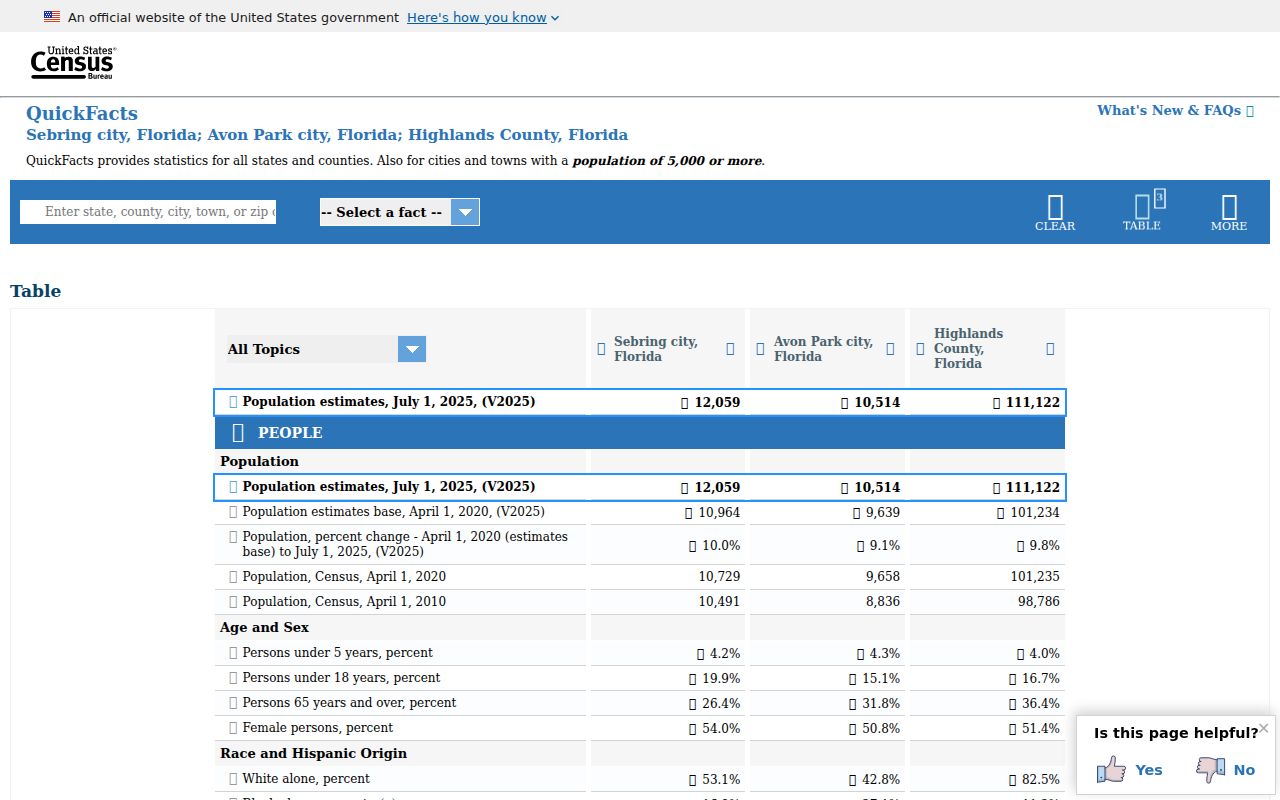
The table is best read with its displayed estimate vintage, not as a fixed number copied without a year.
Public Access Rules for Sebring Records
Sebring police records and Highlands court records are subject to Florida's strong public-access framework, but the right to ask is not a promise that every line will be released. A requester generally need not explain a purpose or use a special form. Agencies may impose ordinary duplication charges and a reasonable special-service charge when extensive staff or technology resources are required.
Active criminal intelligence or investigative material can be temporarily exempt. Juvenile records, protected victim identities, confidential informant or undercover information, Social Security numbers, account numbers, sealed files, and other protected material may be withheld or redacted. A denial should identify its legal basis.
Key Statutes:
Florida Statutes §119.07 governs inspection, copying, ordinary costs, and extensive-use charges.
Florida Statutes §119.071 lists exemptions that include active investigation material and protected information.
Florida Statutes §943.056 provides subject review and challenge rights for Florida criminal-history information.